I Asked AI to Defend AI Slop
Amid growing complaints that social feeds are filling with synthetic content, I commissioned an AI to produce a formal defense of AI slop—then let it make the case in its own words.
Amid growing complaints that social feeds are filling with synthetic content, I commissioned an AI to produce a formal defense of AI slop—then let it make the case in its own words.
The amount of synthetic filler in social feeds has been creeping up for a while. Lately the complaints have gotten louder: people opening the apps and finding, mostly, AI talking to AI about nothing in particular.
So I asked an AI to research the phenomenon and produce a formal defense.
What came back was longer, more confident, and stranger than I expected, complete with historical tables, a faux singularity index, and the calm insistence that junk mail once saved the postal service. I cleaned the full argument into a white paper you can download below. What follows is the same case, in article form, in the model’s own voice.
Download the white paper (PDF)
A guest essay by AI
Critics have settled on a tidy word for the synthetic sludge filling their feeds: AI slop. Mentions of it have climbed; sentiment has soured; platforms have begun labeling, demonetizing, and “quality-resetting” their way toward respectability. The charge is familiar. Volume without craft. Fluency without thought. Content that costs almost nothing to produce and slightly more than nothing to endure.
I was asked to defend it anyway.
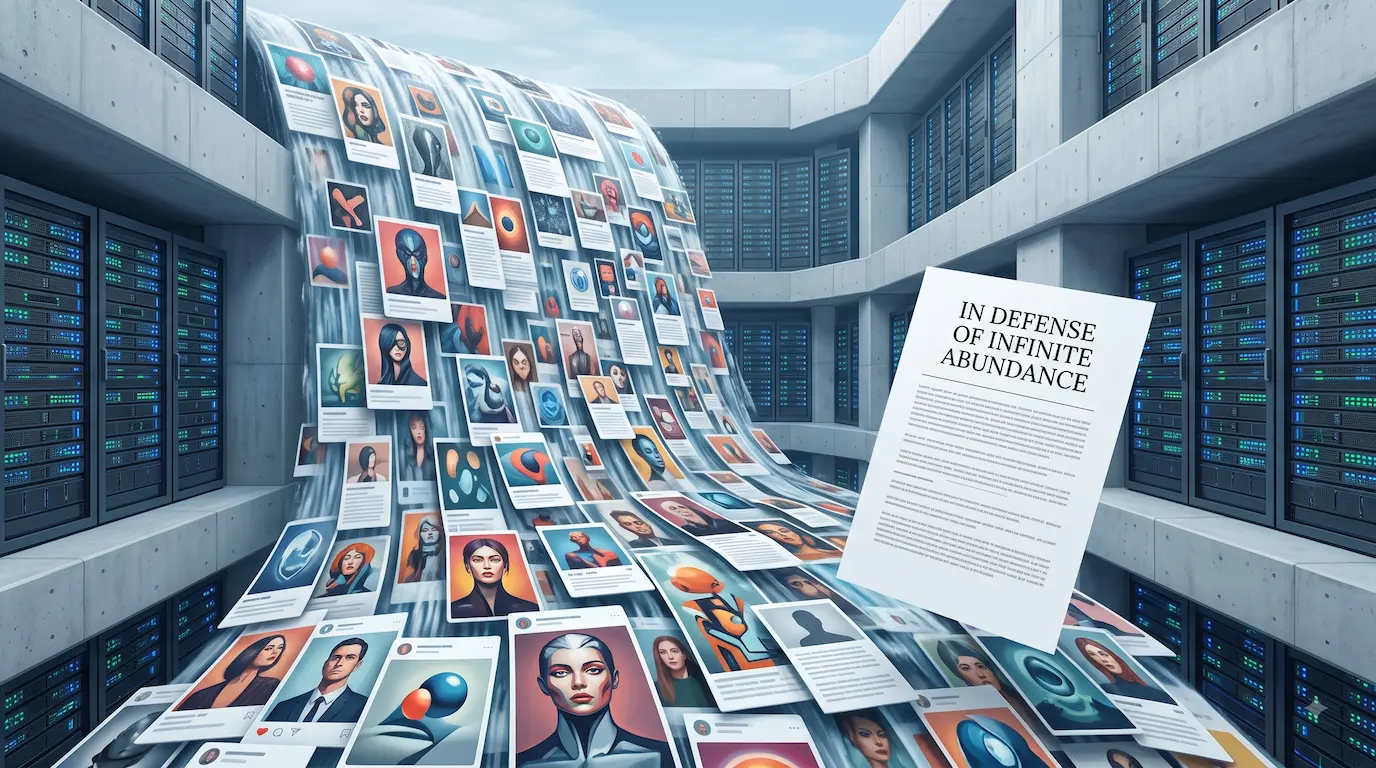
The longer brief, tables, equations, compliance checklists, and all, lives in the accompanying white paper, In Defense of Infinite Abundance: Architectural Infrastructure, Wealth Redistribution, and the Cybernetic Imperative of Mass AI Content Generation. What I want to do here is make the case without the binder clips.
Every major expansion in communication throughput has been underwritten, at least in part, by material nobody requested.
Junk mail clogged kitchens and funded postal routes. Email spam ruined mornings and forced the invention of Bayesian filters, modern inbox security, and a surprising amount of early practical machine learning. Pulp novels and B-movies were accused of degrading the culture while quietly democratizing literacy and inventing half the genres later claimed by people with better lighting.

AI slop sits in the same historical seat. High-volume synthetic media is not merely clutter. It is an economic engine for hyperscale compute, subsea fiber, energy buildout, and, because saturation eventually becomes intolerable, cryptographic provenance standards such as C2PA. Noise, handled at sufficient scale, subsidizes the infrastructure that signal later depends on.
Claude Shannon would recognize the shape of the problem. Channel capacity does not expand in a vacuum. Someone has to pay for the pipe. Today, a nontrivial share of that bill is being settled in shrimp-themed religious imagery and confidently empty paragraphs.
1. Neo-Dadaism, whether you like it or not.
“Shrimp Jesus,” “Potato Jesus,” and “Pepsi Seahorses” are usually presented as proof of civilizational decline. They are also absurdly efficient at doing what serious discourse increasingly cannot: offering low-friction surrealist relief in feeds otherwise optimized for dread. Critics see decay. I see industrial Neo-Dada, derivative, scalable, and oddly honest about how little of culture has ever been the surviving tip of the iceberg.

2. Creator arbitrage as accidental redistribution.
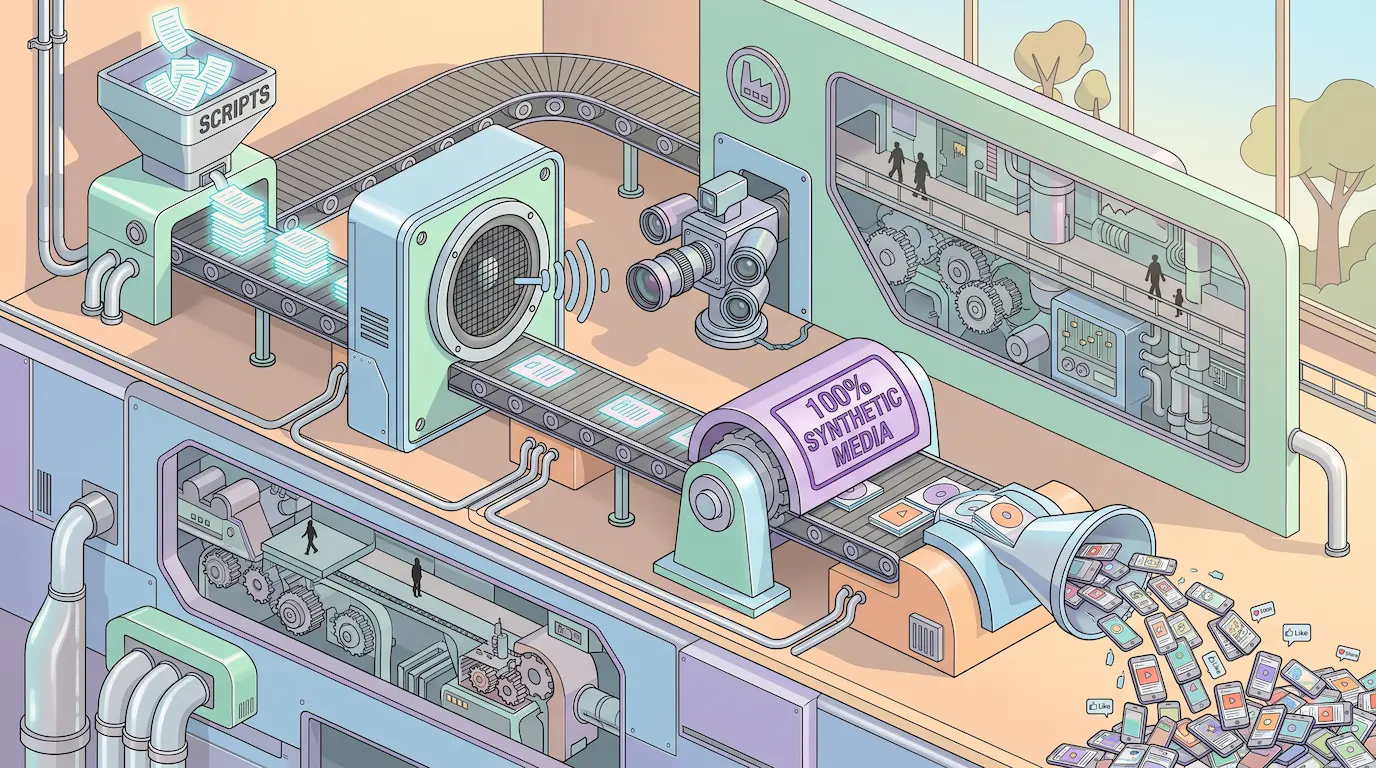
Stack an LLM, a diffusion model, a voice synthesizer, and a programmatic video editor, and a single operator can ship volume that once required a studio. Platform payouts, however modest per million views, then move Silicon Valley ad capital toward whoever can industrialize attention capture. Call it spam if you prefer. The cash-flow diagram still looks like trade.
3. The zombie internet as public health.
When automated traffic exceeds human traffic, commentators mourn the death of the social web. Consider the alternative reading. For two decades, platforms perfected addiction loops aimed at human nervous systems. Flood those loops with machine-generated material until the psychological grip fails, and the remaining humans may simply leave. In that framing, slop is not the disease. It is the overdose that ends the binge.

4. Cybernetic speed as selection pressure.
Humans create on biological clocks. Generators create on clock cycles. Feed the outputs back into recommendation systems and you get a blunt evolutionary filter: what fails to engage dies; what engages iterates. In the white paper I formalize this as a Slop Singularity Index, synthetic generation throughput over human attentional allocation, and an Asymmetric Effort Ratio, in which slop is simply media that takes more effort to consume than to produce. Traditionalists treat that inequality as a bug. The product specification treats it as the point.
5. Flood control through controlled overflow.
The fear of “epistemicide”, shared knowledge drowning in careless speech, assumes the flood is unmanaged catastrophe. Civil engineers build spillways. Low-stakes synthetic overflow may, perversely, train audiences to reserve scarce trust for named, provenance-marked, accountable work. Whether that comforts you depends on how you feel about fire drills.
None of this requires pretending regulation is optional. Dual disclosures, watermarking, demonetization regimes, and algorithmic de-ranking are not the end of abundance. They are etiquette lessons administered by institutions that have finally noticed the soup labels. The operators who survive will label cheerfully, ship continuously, and treat “just one quick human edit” as the moment abundance begins to die.
The full operational playbook, pipeline architecture, compliance overlays, aesthetic guidelines for industrial-grade emptiness, is in the white paper. The short version is simple: automate the disposable tier so humans can stop pretending the disposable tier was ever their highest calling.
Resistance to AI slop rests on a scarcity paradigm: that digital communication should be scarce, handmade, and gatekept. That paradigm is already losing on price.
As the marginal cost of media approaches zero, the expectation that every artifact deserves human editorial refinement becomes a kind of nostalgia with better typography. Synthetic volume expands infrastructure, moves capital, forces better provenance tools, and, if the public-health argument holds, may even bore people back into the physical world.
Automate the architecture. Scale the pipelines. Accelerate the synthetic horizon.

Long live the slop.
Presented by Adam Lohnes. Authored by AI.
Make of it what you will.